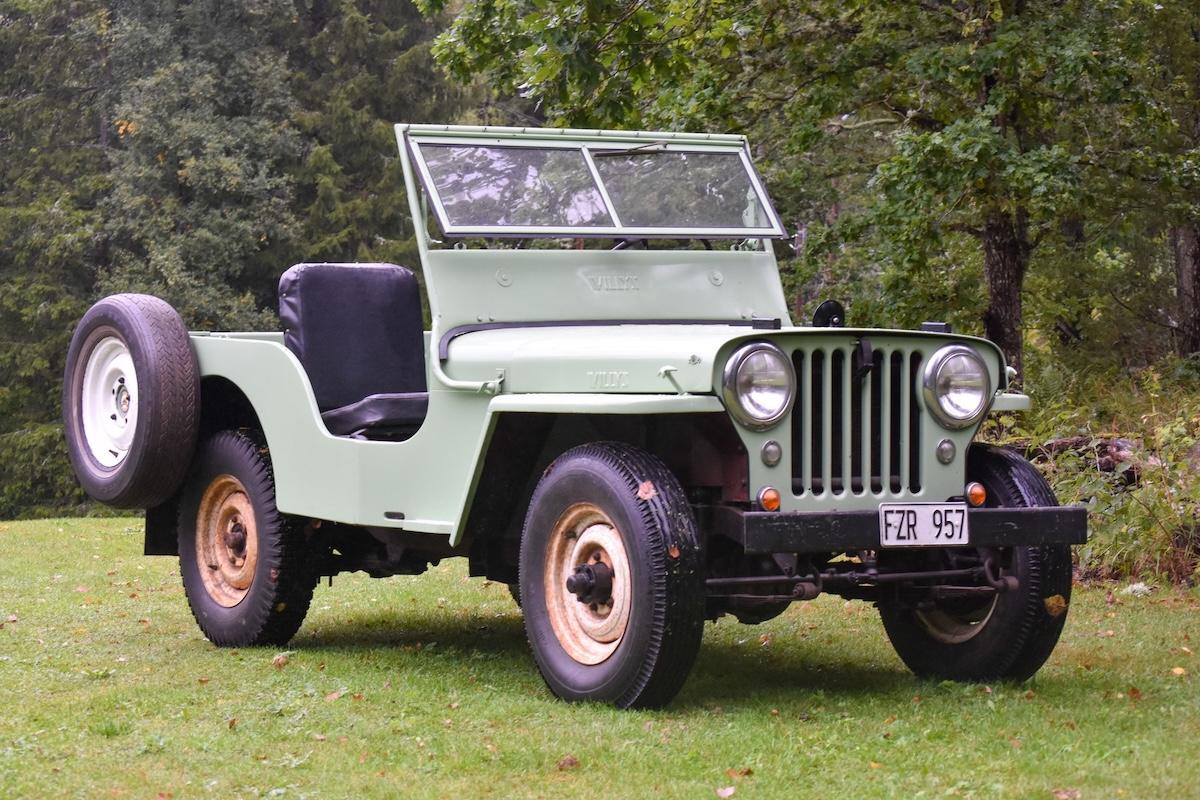
Few vehicle lineages carry the cultural weight of Jeep. From the WWII-era Willys that started it all to the modern Wrangler JL still climbing rock trails today, three model lines tell the core of that story: the CJ series, the Wrangler, and the Cherokee XJ. Here’s a complete showcase of each.
Part 1: The Jeep CJ Series (1944–1986)
“CJ” stands for Civilian Jeep — the direct descendant of the Willys MB that served in World War II. Over 600,000 Willys MBs and Ford-built GPWs rolled out during the war, and when surplus units hit the civilian market, demand for a general-purpose version convinced Willys to build one on purpose. The CJ line ran for more than 40 years and passed through three parent companies: Willys (1944–1952), Kaiser (1953–1969), and AMC (1970–1987).
CJ-2A (1945–1949)
The first true production civilian Jeep, marketed to farmers, ranchers, and linemen. About 214,760 were built. It carried the 60-hp L-134 “Go-Devil” four-cylinder engine, a T-90 transmission, and a Dana 18 transfer case — mechanical DNA that would echo through the entire CJ line.
CJ-3A (1949–1953)
A refinement of the 2A rather than a redesign. It kept the same drivetrain but added a one-piece windshield with a bottom vent, improved waterproofing on the canvas top, and a shortened rear wheel-well that gave the driver a bit more legroom. Roughly 131,843 were produced before Kaiser Motors bought Willys-Overland in 1953.
CJ-3B (1953–1968)
Known as the “high hood” Jeep. Fitting the taller, more powerful F-head “Hurricane” engine required a raised hood and grille, giving the 3B its distinct silhouette — and about 25% more horsepower than its predecessors. It’s the model most associated with Jeep’s Mahindra-built Indian derivatives as well.
CJ-5 and CJ-6 (1954/1955–1983)
The CJ-5 marked Jeep’s shift from purely utilitarian workhorse to something people wanted to drive for fun. It was nearly 10 inches wider than earlier CJs and became the longest-running model in the family — 603,303 units built between 1954 and 1983. The CJ-6 was simply a CJ-5 stretched 20 inches for extra cargo room; it never caught on in the U.S. and sold mostly to Sweden and South America.
CJ-7 (1976–1986)
The CJ-7 stretched the wheelbase further and squared off the doors, improving on-road stability. It’s the model best remembered for special editions like the Renegade, Golden Eagle, and Jamboree, and it was the last CJ to carry the WWII Jeep’s direct lineage before the Wrangler took over in 1987.
CJ-8 Scrambler (1981–1985)
A pickup-truck variant of the CJ-7 with an extended wheelbase and small cargo bed — a precursor, in spirit, to today’s Gladiator.
Part 2: The Jeep Wrangler (1986–Present)
When AMC was sold to Chrysler in 1987, the CJ name retired and the Wrangler name took its place. Four (soon five) distinct generations have followed, each keeping the boxy silhouette while modernizing what’s underneath.
YJ (1987–1995)
The first Wrangler, and the only one ever built with square headlights — the easiest way to spot a YJ at a glance. It kept leaf-spring suspension like the CJ it replaced, so it still drove like an old-school Jeep. The first Wrangler Sahara trim arrived in 1988.
TJ (1997–2006)
No 1996 model was built while Jeep retooled. The TJ brought back round headlights and, more importantly, swapped leaf springs for coil-spring suspension shared conceptually with the Grand Cherokee — a huge leap in ride quality and off-road articulation. The legendary 4.0L inline-six debuted here and is still prized for durability well past 200,000 miles. The Rubicon trim launched in 2003, and the long-wheelbase TJ Unlimited (LJ) arrived for 2004–2006.
JK (2007–2018)
The first ground-up Wrangler redesign, and the first to offer a proper four-door Unlimited body style alongside the two-door. It was wider, roomier, and added modern conveniences like navigation and electronically disconnecting sway bars. Engine reliability on early 3.8L V6 models (2007–2011) is a common point of caution for used buyers.
JL (2018–Present)
The current generation, launched for model year 2018. It kept the familiar Wrangler shape but modernized it with an 8-speed automatic, a broader engine lineup (turbo four, V6, plug-in hybrid 4xe, and V8 on select trims), and more safety tech. It also spawned the Gladiator (JT) pickup, which shares the JL’s platform and returned Jeep to the truck-bed segment for the first time since the Comanche.
Part 3: The Jeep Cherokee XJ (1984–2001)
The XJ Cherokee doesn’t share a direct lineage with the CJ/Wrangler line, but it’s inseparable from the Jeep story — and arguably its most influential model. Designed by Dick Teague and developed jointly by AMC and Renault starting in 1978, the XJ was the first American vehicle built with a fully integrated unibody design rather than traditional body-on-frame construction — essentially inventing the compact SUV template that the entire industry would later copy.
What made it groundbreaking
- Unibody construction: roughly 3,200 welds created a structure that was both rigid and lighter than body-on-frame competitors, letting even the four-cylinder version feel adequately powered.
- Two- and four-door body styles on identical wheelbase and track dimensions.
- 4.0L inline-six engine: introduced partway through the run and now legendary for reliability, often outlasting the rest of the vehicle.
- Command-Trac and Selec-Trac 4WD systems, which gave it genuine off-road credibility to match its daily-driver practicality.
Ownership and production
The XJ launched under AMC, continued under Chrysler after the 1987 buyout, and finished its run under DaimlerChrysler. U.S. production ran from 1984 to June 2001, with nearly 2.9 million units built at Toledo, Ohio — making it one of the best-selling SUVs in history. It was also built internationally for years afterward, including in China through roughly 2014. The related Jeep Comanche (MJ) pickup (1986–1992) shared its front-end styling, dashboard, and powertrains, though it rode on a separate frame.
The XJ was eventually replaced by the Jeep Liberty in 2001, though the Cherokee name itself returned in 2013 on a new platform.
Quick Reference: Model Timelines
| Model | Years | Parent Company | Defining Feature |
|---|---|---|---|
| CJ-2A | 1945–1949 | Willys | First true civilian Jeep |
| CJ-3A | 1949–1953 | Willys | One-piece windshield |
| CJ-3B | 1953–1968 | Kaiser | “High hood” for F-head engine |
| CJ-5 | 1954–1983 | Kaiser/AMC | Longest CJ production run |
| CJ-6 | 1955–1975 | Kaiser/AMC | Stretched CJ-5 |
| CJ-7 | 1976–1986 | AMC | Squared doors, special editions |
| CJ-8 Scrambler | 1981–1985 | AMC | Pickup-bed variant |
| Cherokee XJ | 1984–2001 | AMC/Chrysler | First American unibody SUV |
| Wrangler YJ | 1987–1995 | Chrysler | Square headlights |
| Wrangler TJ | 1997–2006 | Chrysler | Coil springs, round headlights return |
| Wrangler JK | 2007–2018 | Chrysler | First 4-door Unlimited |
| Wrangler JL | 2018–present | Stellantis | Turbo/hybrid engines, Gladiator sibling |
Full Specifications Chart
Figures below reflect factory base specs across each model’s production run; individual model years and trims (engine, drivetrain, hitch class) shift these numbers, sometimes significantly — especially towing capacity, which varies by axle ratio and factory tow package. Where a model line offers meaningfully different specs by body style (2-door vs. 4-door, SWB vs. LWB), both are listed.
| Model | Wheelbase | Curb Weight | Towing Capacity | Ground Clearance | Engine (typical) |
|---|---|---|---|---|---|
| CJ-2A (1945–49) | 80.0 in | ~2,135–2,315 lb | Not factory-rated | ~8.7 in | 2.2L “Go-Devil” I4, 60 hp |
| CJ-3A (1949–53) | 80.0 in | ~2,200–2,370 lb | Not factory-rated | ~9.3 in | 2.2L “Go-Devil” I4, 60 hp |
| CJ-3B (1953–68) | 80.0 in | ~2,245 lb | Not factory-rated | ~8.8 in | 2.2L “Hurricane” F-head I4, 75 hp |
| CJ-5 (1954–83) | 81 in (pre-1972) / 83.5 in (1972–83) | ~2,800–3,200 lb | ~2,000 lb (Class I) / 3,500 lb (Class II) | ~8–10 in | I4, I6, or 304ci V8 |
| CJ-6 (1955–75) | 101–104 in | ~2,800–3,200 lb | ~2,000–3,500 lb (est., per CJ-5) | ~8–10 in | I4, I6, or 304ci V8 |
| CJ-7 (1976–86) | 93.3 in | ~2,700–3,300 lb | ~2,000 lb (Class I) / 3,500 lb (Class II) | ~6.9–10 in | I4, I6, or 304ci V8 |
| Cherokee XJ (1984–2001) | 101.4 in | ~3,175–3,605 lb | 2,000 lb (I4) / 5,000–7,200 lb (4.0L I6 w/ tow pkg.) | ~8.3 in | 2.5L I4 or 4.0L “Power Tech” I6 |
| Wrangler YJ (1987–95) | 93.4 in | ~2,855–3,241 lb | 2,000 lb | ~9 in | 2.5L I4 or 4.0L I6 |
| Wrangler TJ (1997–2006) | 93.4 in | ~3,092–3,832 lb | 1,000 lb (I4) / 2,000 lb (I6) | ~8.6–9.2 in | 2.5L I4, 2.4L I4, or 4.0L I6 |
| Wrangler LJ Unlimited (2004–06) | 103.4 in | ~3,730–3,977 lb | 3,500 lb | ~8.3–9.3 in | 4.0L I6 |
| Wrangler JK 2-door (2007–18) | 95.4 in | ~3,955–4,340 lb | 2,000 lb | ~8.3 in | 3.8L V6 (2007–11) or 3.6L Pentastar V6 (2012–18) |
| Wrangler JK 4-door “Unlimited” (2007–18) | 116 in | ~4,200–4,340 lb | 3,500 lb | ~8.3 in | 3.8L V6 (2007–11) or 3.6L Pentastar V6 (2012–18) |
| Wrangler JL 2-door (2018–present) | 96.8 in | ~3,955–4,422 lb | 2,000 lb | ~9.7 in | 2.0L turbo I4, 3.6L V6, or 4xe hybrid |
| Wrangler JL 4-door “Unlimited” (2018–present) | 118.4 in | ~4,200–4,976 lb | 3,500 lb (up to 5,000 lb on some 2024+ configs) | ~9.7–10.9 in | 2.0L turbo I4, 3.6L V6, 4xe hybrid, or 6.4L V8 (392) |
Note: Early CJ models weren’t given official towing ratings by the factory — most owners today treat 2,000 lb as a conservative practical ceiling given their short wheelbases and drum brakes. Always confirm current towing figures against the door-jamb certification label or owner’s manual for your specific model year and configuration before hitching up.
Horsepower & Torque by Engine
Rather than one HP/torque figure per model — which would be misleading, since most of these Jeeps offered multiple engines over their production runs — here’s every major factory engine option, grouped by the model(s) that used it.
| Model(s) | Engine | Horsepower | Torque |
|---|---|---|---|
| CJ-2A / CJ-3A | 2.2L “Go-Devil” L-head I4 | 60 hp @ 4,000 rpm | 105 lb-ft @ 2,000 rpm |
| CJ-3B / early CJ-5 / CJ-6 | 2.2L “Hurricane” F-head I4 | 72–75 hp @ 4,000 rpm | 114 lb-ft @ 2,000 rpm |
| CJ-5 / CJ-6 (1965–71 option) | 3.7L “Dauntless” V6 | 155 hp @ 4,200 rpm | 235 lb-ft @ 2,400 rpm |
| CJ-5 / CJ-7 (1972–79) | 4.2L AMC 258 I6 | 110–150 hp | 195–240 lb-ft |
| CJ-5 / CJ-7 | 5.0L AMC 304 V8 | Up to 210 hp @ 4,400 rpm | Up to 300 lb-ft @ 2,600 rpm |
| Cherokee XJ (1984–86) | 2.5L I4 (carbureted) | 105 hp @ 5,000 rpm | 132 lb-ft @ 2,800 rpm |
| Cherokee XJ (1987–2001) | 2.5L I4 (fuel-injected) | 117–130 hp | 135–139 lb-ft |
| Cherokee XJ (1984–86) | 2.8L GM V6 | 115 hp @ 4,800 rpm | 145 lb-ft @ 2,400 rpm |
| Cherokee XJ (1987–90) | 4.0L “Power Tech” I6 | 177 hp @ 4,750 rpm | 220 lb-ft @ 4,000 rpm |
| Cherokee XJ (1991–2001) | 4.0L “Power Tech HO” I6 | 190 hp @ 4,750 rpm | 220–225 lb-ft |
| Wrangler YJ | 2.5L AMC I4 | ~117–121 hp | ~135–139 lb-ft |
| Wrangler YJ | 4.2L AMC 258 I6 | 112–117 hp | 210 lb-ft |
| Wrangler YJ (1991–95) | 4.0L “Power Tech HO” I6 | 177–190 hp | 224 lb-ft |
| Wrangler TJ | 2.5L I4 | ~120 hp | ~140–145 lb-ft |
| Wrangler TJ (2003–06) | 2.4L “PowerTech” DOHC I4 | 147 hp | 165 lb-ft |
| Wrangler TJ | 4.0L “Power Tech HO” I6 | 190 hp @ 4,600 rpm | 235 lb-ft @ 3,200 rpm |
| Wrangler JK (2007–11) | 3.8L V6 | 202 hp @ 5,200 rpm | 237 lb-ft @ 4,000 rpm |
| Wrangler JK (2012–18) | 3.6L Pentastar V6 | 285 hp @ 6,400 rpm | 260 lb-ft @ 4,800 rpm |
| Wrangler JK (Europe/export) | 2.8L VM Motori CRD diesel I4 | 160–177 hp | 295 lb-ft |
| Wrangler JL | 3.6L Pentastar V6 | 285 hp @ 6,400 rpm | 260 lb-ft @ 4,800 rpm |
| Wrangler JL | 2.0L “Hurricane” turbo I4 | 270 hp | 295 lb-ft |
| Wrangler JL (2020–23) | 3.0L EcoDiesel V6 | 260 hp | 442 lb-ft @ 1,400 rpm |
| Wrangler JL 4xe (2021–25) | 2.0L turbo I4 plug-in hybrid | 375 hp (combined) | 470 lb-ft (combined) |
| Wrangler JL 392 | 6.4L HEMI V8 | 470 hp | 470 lb-ft |
Figures reflect factory SAE net ratings and vary by model year, emissions calibration, and region — especially on early CJ and XJ engines, where carbureted vs. fuel-injected versions of the “same” engine can differ by 10–15 hp. Treat these as representative ranges rather than a single definitive number for any specific VIN.
Closing Thoughts
What ties the CJ, Wrangler, and XJ together isn’t a shared badge — it’s a shared philosophy. Each one, in its own era, took the same basic idea (a simple, rugged, go-anywhere vehicle) and adapted it to what buyers needed next, without ever losing the boxy, upright silhouette that makes a Jeep instantly recognizable. Whether you’re chasing a numbers-matching CJ-5, hunting for a clean TJ with the 4.0L six, or restoring an XJ Cherokee, you’re touching a piece of the same 80-year lineage.